
European Hemp Market
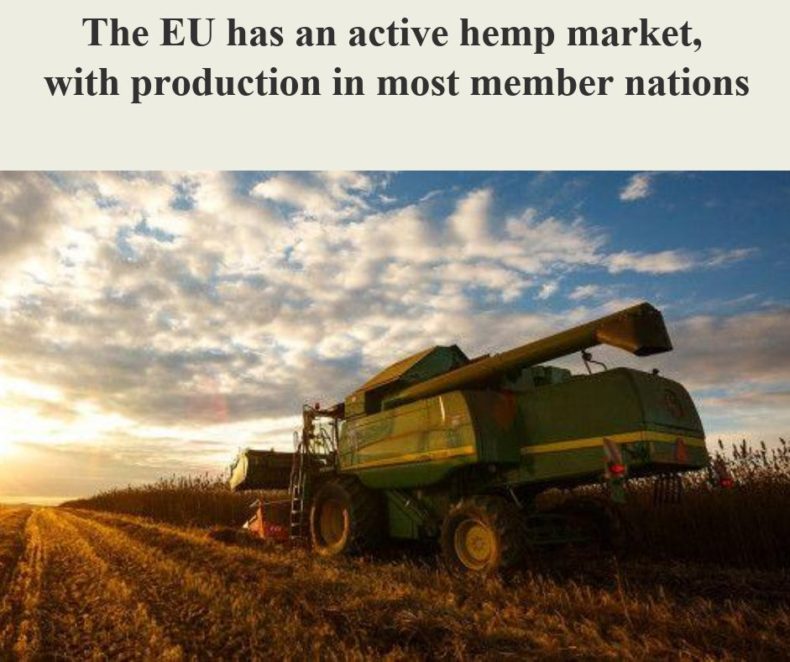
The EU has an active hemp market, with production in most member nations. Production is centered in France, the Netherlands, Lithuania, and Romania. France is the main producer of hemp, accounting for almost 50% of Europe’s total production. Baltic area has rapidly emerged to become the region’s second biggest hemp grower.
Many EU countries lifted their bans on hemp production in the 1990s and, until recently, also subsidized the production of “flax and hemp” under the EU’s Common Agricultural Policy. Most EU production is of hurds, seeds, fibers, and pharmaceuticals. Europe, particularly France and Finland, have a long history using hemp for fibres, construction material and textiles, though in the last 25 years this sector has come into bloom, increasing production by upwards of 500% (that’s 250% in 8 years).
The demand for hemp has been fueled by the increasingly diverse use of this cash crop. In recent years the area dedicated to hemp cultivation has increased significantly in the EU from 20,540 hectares (ha) in 2015 to 33,020 ha in 2022 (a 60% increase). In the same period, the production of hemp increased from 97,130 tonnes to 179,020 tonnes (a 84.3% increase).
The EU has subsidized the European hemp market over the last 20 years as part of green policy initiatives. However, with greater demand and stronger prices being recorded, the European market is beginning to move towards a free market model.
European CBD Market
Hemp is also an excellent source of CBD, which can be extracted for use in an array of food supplements, pharmaceuticals and cosmetics. Although the legal cannabis market in Europe is targeted strictly towards medical consumers, the consumption of hemp-derived CBD infused products for recreational purposes is legally permitted across much of the continent.
Within Europe, select countries have a more profound impact on the CBD market. For instance, Switzerland legally permits the sale, possession, and consumption of both legal and recreational CBD with a THC content as high as 1.0 %. Furthermore, CBD products are available for purchase in tobacco shops. As a result, the softening of THC limitations and ease of consumer access makes Switzerland one of the biggest European players within the CBD market.
As detailed in IHS Markit’s latest release, the total EU CBD market value is estimated at €1.6 billion in 2020 and it is projected to grow at a combined annual growth rate (CAGR) of 18.5%, to reach €8.7 billion by 2030.
Full Article: hempcbdbusinessplans.com.
We offer Hemp/CBD Business Plan Templates to help with creating a professional business plan for a hemp/CBD business to break down the costs and forecast the profits, to know how much it will take to get into the business.